
The 80/20 Rule for Hospitality Marketing
Marketing Strategy · Hospitality
Contents
The 80/20 Rule for Hospitality Marketing: Stop Doing More, Start Doing Less
The short version:
- 80% of your bookings come from 20% of your marketing activity. Most operators don’t know which 20%.
- The fix isn’t doing more. It’s building a scorecard that shows which channels actually convert to covers — then cutting or de-prioritising everything that doesn’t.
- For most pubs and restaurants, the high-impact 20% is Google Ads for capture, local SEO for discovery, CRM for retention. That’s where the budget should concentrate.
- The goal isn’t a busier marketing plan. It’s a more commercial one.
This is the trap the 80/20 rule is designed to break. The Pareto Principle — that 80% of outcomes come from 20% of effort — applies to hospitality marketing with unusual precision. Most pubs and restaurants could cut half their marketing activity, concentrate budget on what remains, and end up with more covers, not fewer.
The difficulty is identifying which 20% to keep. This piece is about how to do that.
The real problem isn’t doing too little
When I talk to founders and MDs running hospitality groups, the common refrain is some version of “we need to do more marketing.” More social media. More email campaigns. More channels. A bigger presence everywhere.
Almost always, the problem is the opposite. The business is already doing enough — it’s just doing it across too many fronts, without the clarity to know what’s converting. Budget gets fragmented. Channels operate in silos. The team is busy but the bookings needle doesn’t move proportionally to the effort going in.
“Can I draw a direct line from this marketing activity to a booking or a cover?” If the answer is no — or “not really” or “it probably helps with awareness” — that activity is almost certainly in the 80%.
The shift from “more marketing” to “more commercial marketing” is the most valuable thing most hospitality operators can make. It means being willing to stop doing things that feel productive but don’t convert, and concentrating on fewer activities that demonstrably drive revenue.
How to find your 20%
You can’t identify the vital 20% without measurement. If your current tracking can’t tell you which channels are driving bookings, you’re making budget decisions on instinct — and instinct in marketing almost always overweights visible, activity-heavy channels (social media) and underweights quieter, high-converting ones (Google Ads, local SEO, CRM).
Start with booking signals, not traffic
Traffic is a means to an end. What you need to track are booking signals — actions that indicate high intent:
- “Book a table” button clicks on your website
- Booking engine starts and completions
- Phone call clicks from search results
- Direction requests from Google Business Profile
- Reservation confirmations where your system allows attribution
Set up Google Analytics 4 events for each of these if you haven’t already. Without them, you’re looking at pageviews and impressions — which tell you people visited, not whether they booked.
Run a channel audit
List every active marketing channel. For each one, ask: what’s the cost (time + money), and how many bookings can we attribute to it? Some will be easy — Google Ads has clear cost-per-click data, CRM has trackable email campaigns. Others will be harder — organic social is notoriously difficult to attribute. That difficulty is itself a signal.
Channels that are hard to attribute are often also the ones generating the most activity and consuming the most time. That’s not a coincidence.
The channels that consistently make the cut
Across the hospitality businesses I’ve worked with — from single-site destination restaurants to pub groups of ten venues — three channels consistently appear in the productive 20%:
Google Ads — capture
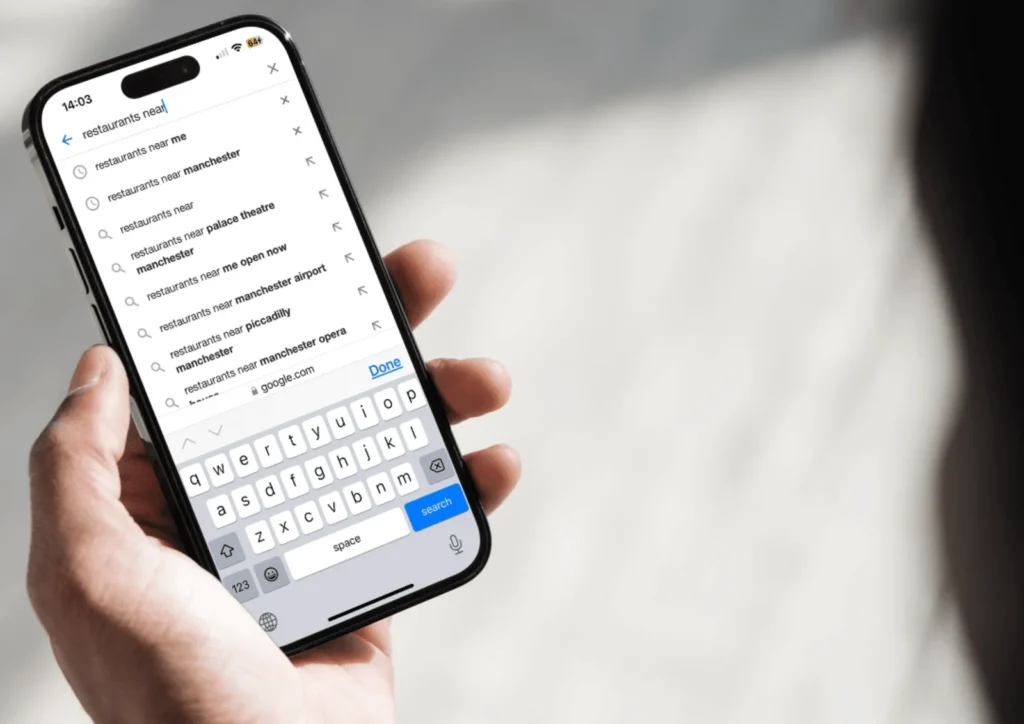
When someone searches “restaurants near me” or “book a table in Soho” with intent to book tonight or this weekend, Google Ads is the mechanism that captures them. The search intent is high, the journey from click to booking is short, and cost-per-cover can be tracked directly. It’s not always cheap, but it’s attributable — which puts it in a different category to most other channels.
The failure mode with Google Ads in hospitality is poor structure: broad match keywords, weak landing pages, no conversion tracking. A well-structured campaign pointed at a high-converting booking page is one of the most reliable revenue levers available to a pub or restaurant.
Local SEO — discovery
For pubs and restaurants, local SEO is primarily about the Google Maps Local 3-Pack — the three listings that appear at the top of search results for “pubs near me” or “restaurant [area].” Ranking consistently in the 3-Pack for your primary queries can double or triple the volume of high-intent visitors to your site and booking engine.
The investment is in your Google Business Profile, your review programme, and citation consistency — not in ongoing ad spend. Once built, local SEO compounds. That’s why it belongs in the 20%.
We cover the mechanics of local SEO in detail in our guide to winning the Local 3-Pack for pubs and restaurants.
CRM and email — retention
Your existing customer database is consistently the most underused revenue asset in hospitality. A guest who’s booked before is significantly more likely to book again — they’ve already chosen you once. A well-structured CRM programme (a win-back sequence for lapsed bookers, a pre-birthday trigger, a seasonal offer to regulars) consistently delivers among the highest ROI of any marketing activity, at very low cost.
Most hospitality businesses have the data. Few have the automation. This is one of the first things we set up inside every restaurant marketing engagement — it’s quick to implement and immediately attributable.
What to cut from the 80%
Cutting is harder than adding. Every channel in the 80% has an internal advocate — usually whoever runs it — and reducing or removing it feels like going backwards. It isn’t. It’s freeing up budget and attention for what actually converts.
Common entries in the 80% for hospitality:
- Daily social media posting without conversion goals. Social is a brand and retention channel, not a booking engine. Post less, more deliberately. Don’t measure success by likes.
- Broadcast email blasts with no segmentation. Sending the same offer to every address in your database at the same time produces mediocre results. Segmented, automated CRM sequences outperform mass sends consistently.
- Generic PR and awards entries. Unless an award shortlist generates a credible backlink or direct press coverage that reaches your ICP, it’s time spent on brand theatre not revenue.
- Being on every platform. TikTok, Pinterest, Snapchat, Threads — the question isn’t whether your customers are there, it’s whether they use those platforms to decide where to eat or drink. Usually they don’t.
- Awareness campaigns without a conversion layer. Brand awareness has a place in large group marketing. For most independent pubs and restaurants, it’s a luxury. Every campaign should have a booking CTA and tracking behind it.
The scorecard that makes this sustainable
The 80/20 approach only holds if you maintain visibility into what’s working. Without a regular reporting cadence, the 80% creeps back in — a new channel gets added because a competitor is doing it, a campaign gets launched because it “feels right for the brand,” budget drifts toward activity and away from outcomes.
The mechanism to prevent this is a weekly scorecard with four or five numbers that the whole team — marketing, ops, finance — can read and act on. Not a 40-slide deck. A single document that answers: what drove bookings this week, what didn’t, and what are we doing differently next week as a result.
- Covers or bookings driven by channel (where attributable)
- Cost per acquired booking by paid channel
- Google Business Profile actions: calls, directions, website clicks
- Email revenue or click-to-book rate from CRM campaigns
- Local search rank / Share of Local Voice (monthly)
Five numbers. One document. Reviewed weekly. That’s the operating cadence that keeps marketing pointed at revenue rather than activity — which is the whole point of the 80/20 approach.
This is exactly how we structure reporting inside every hospitality marketing engagement — one scorecard, one owner, one weekly review that ties everything back to bookings and covers.
FAQ
What is the 80/20 rule in hospitality marketing?
The 80/20 rule means that roughly 80% of your bookings and revenue come from 20% of your marketing activity. The challenge is identifying which 20% — and eliminating or reducing the 80% that isn’t pulling its weight. For most pubs and restaurants, the high-impact 20% is typically Google Ads for capture, local SEO for discovery, and CRM for retention.
How do I know which marketing activities are driving revenue?
You need clean tracking and a single scorecard. At minimum, track booking button clicks, booking starts, call clicks, and direction requests from each channel. Where possible, connect this to actual confirmed bookings through your reservation system. If you can’t see which channels are driving bookings, you’re making budget decisions blind.
What should a pub or restaurant stop doing to free up marketing budget?
Common low-ROI activities: posting daily on every social platform without a conversion goal, running broad awareness ads without tracking to bookings, maintaining channels your customers don’t use to make booking decisions, and creating generic content that doesn’t rank or convert. The test for any activity: can you draw a direct line to bookings or revenue? If not, it’s in the 80% to cut.
How often should a hospitality business review its marketing priorities?
Monthly at minimum, quarterly for a full strategic review. The channel mix that drives covers in January is often different from what drives covers in August. A good hospitality marketing plan has a live scorecard reviewed weekly and a channel allocation reviewed every quarter to reallocate budget toward what’s working.