How to Increase Direct Bookings for Restaurants and Pubs (UK 2026)
Restaurant Marketing · Direct Bookings
Contents
- 1 How to Increase Direct Bookings for Restaurants and Pubs
- 1.1 The direct booking problem most operators don’t measure
- 1.2 Step 1 — Fix your booking funnel
- 1.3 Step 2 — Own your guest data
- 1.4 Step 3 — Google Ads for direct booking capture
- 1.5 Step 4 — CRM and email for repeat bookings
- 1.6 Step 5 — Give guests a reason to book direct
- 1.7 How to measure your direct booking rate
- 1.8 FAQ
- 1.8.1 How can restaurants reduce OTA commission and increase direct bookings?
- 1.8.2 What percentage of restaurant bookings should be direct?
- 1.8.3 Should restaurants use OpenTable, ResDiary or their own booking system?
- 1.8.4 How much does OTA commission cost a restaurant?
- 1.8.5 What is the best way to get repeat bookings from restaurant guests?
How to Increase Direct Bookings for Restaurants and Pubs
The short version:
- Most restaurants and pubs are over-reliant on OTAs for bookings — paying commission on guests who would have come direct if the right systems were in place.
- The fix is not complicated: own your booking funnel, capture your guest data, run Google Ads on branded terms, and build a simple CRM retention sequence.
- Well-run independent operators achieve 60–80% direct bookings. Most sit at 40–50% and are leaving significant margin on the table.
- Every cover shifted from OTA to direct saves commission and gives you the guest data to bring them back again.
On this page
I ran this programme at scale inside Young’s across 230+ pubs. Here is what actually moves the number.
The direct booking problem most operators don’t measure
Most operators don’t know their direct booking percentage. They know total covers. They might know OTA covers if the platform sends a monthly summary. But they rarely have a single number that says: of all the bookings we took this month, what percentage came through our own channel?
That number matters because it tells you how dependent you are on a channel you don’t own and can’t control. OTA commission rates change. Platforms add competing restaurants to your listing page. Your guests see offers from your competitors before they confirm a booking with you. Every booking that goes through an OTA instead of your own system is a guest whose contact details you don’t have and who will be marketed to by the platform after they visit.
A rough cost calculation:
If your average spend per cover is £45 and you take 400 OTA-sourced covers per month at a 3% commission rate — that is £540/month, £6,480/year, in commission on guests you don’t own. Shifting 200 of those covers to direct saves £3,240/year and gives you 200 additional guest records to market to. That is a material number for most independent operators.
Step 1 — Fix your booking funnel
Before spending anything on marketing, audit the journey from search to confirmed booking on your own channel. Most restaurants and pubs have at least one significant drop-off point that is costing them direct bookings every day.
Check 1
Open your website on a real iPhone, not just a browser emulator. Is “Book a Table” visible without scrolling? If the button is below the hero image, in the navigation only, or absent from the mobile layout, you are losing bookings at the first hurdle. This is a five-minute Divi fix that pays back immediately.
Check 2
Does your booking engine load quickly and work on mobile?
Test the entire booking flow on your phone — from clicking “Book a Table” to receiving the confirmation email. Time it. If it takes more than 30 seconds or requires more than four taps, guests will abandon it. Most OTA booking flows are faster and smoother than restaurant websites, which is a large part of why guests use them. Fix the speed problem first.
Check 3
Does your Google Business Profile link to your booking page?
Your GBP listing has a dedicated booking URL field. Most operators leave it pointing to their homepage, which then requires the guest to find the booking button themselves. Set the GBP booking URL to link directly to your booking engine page. This one change reduces drop-off for guests who find you on Google Maps.
Check 4
Is there a direct booking option on every OTA listing?
Most OTA platforms allow you to add your own website URL to your listing. Make sure it is there, it links to your booking page (not your homepage), and it is up to date. Some guests will click through to your site even from an OTA listing — catch them when they do.
Step 2 — Own your guest data
Every booking taken through your own platform generates a guest record that belongs to you. Every booking taken through an OTA generates a guest record that belongs to them. Over time, an operator with a strong direct booking channel builds an owned database of thousands of guests they can market to without paying a platform. An operator dependent on OTAs builds nothing they own.
Choose a booking platform with a direct booking widget
ResDiary, SevenRooms, OpenTable Direct, and Tock all offer embeddable booking widgets that sit on your own website and route bookings through your own account — so the guest data flows to you, not to a marketplace. If you’re currently using a booking platform’s marketplace only, you’re giving away the relationship. Switch to a setup where the widget on your site is the primary booking channel and the marketplace listing is secondary discovery.
Send confirmation emails from your own domain
Many booking platforms send confirmation emails from their own domain — “@resdiary.com” or “@opentable.com” — rather than from yours. Where the platform allows it, configure confirmation emails to come from your own domain (e.g. bookings@thecrown.co.uk). This reinforces your brand at the moment of highest engagement and starts the relationship under your name rather than the platform’s.
Capture email at every touchpoint
Walk-ins, phone bookings, event enquiries — every guest interaction is an opportunity to capture an email address. A simple “can I take your email for booking confirmation?” at the point of taking a phone reservation costs nothing and builds your database one record at a time. Add this to your team’s standard process and review it quarterly.
Step 3 — Google Ads for direct booking capture
The highest-value Google Ads tactic for increasing direct bookings is also the one most restaurants miss: bidding on your own brand name.
Brand protection campaigns
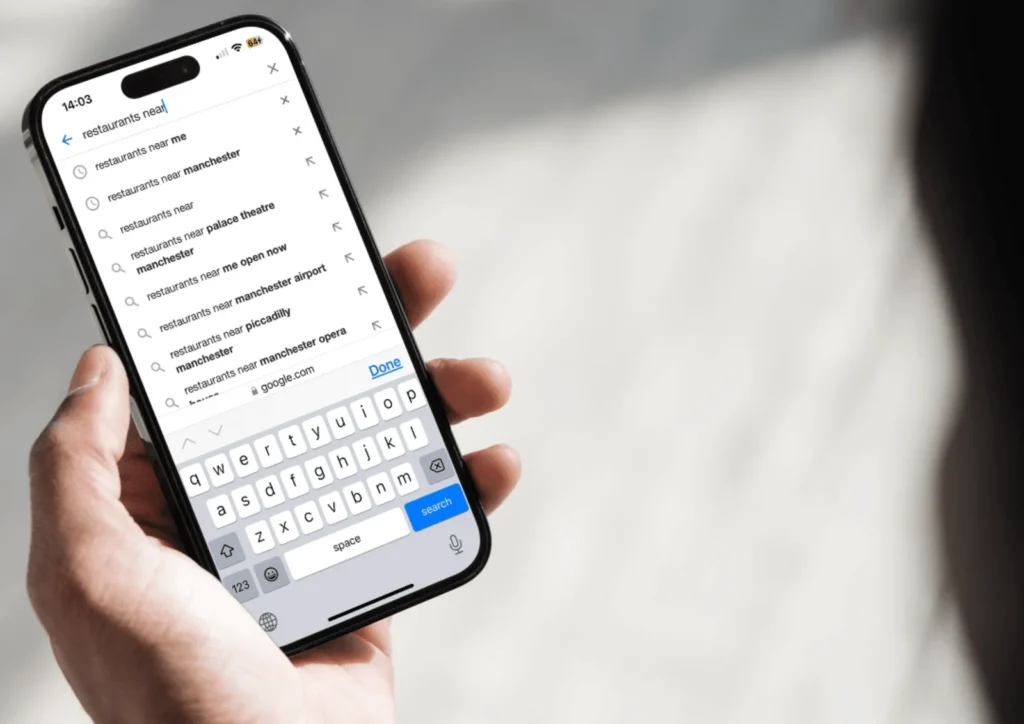
When a guest searches your restaurant’s name on Google, OTAs like OpenTable and DesignMyNight often appear above your own website in the paid results — bidding on your brand name to capture the booking and charge you commission. A brand protection campaign costs pennies per click on your own name and ensures that guests searching specifically for you land on your booking page, not an OTA.
Run a brand campaign. Set the destination as your booking page directly. Keep bids low — these are high-intent searches with minimal competition once you’re bidding on your own name. The cost is almost always significantly lower than the commission you’d pay the OTA on the same booking.
Local search campaigns for high-intent queries
Beyond brand terms, campaigns targeting “restaurants [area]”, “book a table [area]”, and occasion-based searches (“birthday dinner [area]”, “anniversary restaurant [area]”) capture guests at the point of decision. These guests are ready to book — they need to land on a page that makes it easy to do so. A dedicated landing page with the booking widget above the fold, strong photography, your Google review rating, and a single CTA converts significantly better than your homepage.
We cover the mechanics of Google Ads for restaurants in detail in our restaurant marketing engagement — it is consistently one of the highest-ROI channels for direct bookings when set up correctly.
Step 4 — CRM and email for repeat bookings
The most cost-effective direct booking channel you have is your existing guest database. A guest who has already dined with you, has a positive experience, and is on your mailing list is significantly more likely to book again than a cold prospect — and they cost nothing to reach via email.
Most restaurants have a database. Most do nothing systematic with it. The gap between having a database and using it properly is almost always one of structure rather than budget.
Three sequences that drive repeat bookings
Sequence 1
Post-visit follow-up (send 48 hours after booking)
“We hope you enjoyed your visit. We’d love to see you again soon — here’s a direct link to book your next table.” Include a Google review request in the same email. One email, two outcomes: a repeat booking opportunity and a review request. Open rates on post-visit emails are significantly higher than broadcast newsletters because the timing is personal and the guest is still warm.
Sequence 2
Win-back sequence (trigger at 90 days of inactivity)
A guest who visited 90 days ago and hasn’t returned is lapsing. A single well-timed email — “We haven’t seen you for a while. Here’s what’s new and a direct link to book” — with a specific reason to return (new menu, upcoming event, seasonal offer) consistently brings guests back who would otherwise have booked somewhere else by default.
Sequence 3
Birthday and anniversary triggers
If your booking platform captures birthday or anniversary data, a triggered email in the week before the occasion drives bookings with very high conversion rates. Occasion dining is the easiest booking to win back because the guest is actively looking for a venue — and you already have a relationship with them. Keep the email simple: acknowledge the occasion, make the booking easy, and offer a small direct incentive (priority table, a welcome drink).
Which CRM platforms work well for hospitality?
Airship and Stampede are built specifically for hospitality and integrate with most major booking platforms. Klaviyo is a strong option for operators who want more flexibility. The platform matters less than the sequences — three well-timed automated emails consistently outperform twelve broadcast newsletters per year.
Step 5 — Give guests a reason to book direct
Direct booking incentives are one of the most underused tools in hospitality marketing. The assumption is that incentives mean discounts — which eat into margin and train guests to expect reduced prices. That is the wrong approach.
The most effective direct booking incentives add perceived value without significant cost:
- Priority table selection. Guests who book direct can choose their preferred table or section. OTA bookings get standard allocation. This costs nothing and makes direct booking feel premium rather than transactional.
- A complimentary welcome drink or amuse-bouche. A glass of house wine or a small bite costs £2–£4. OTA commission on the same booking costs significantly more. The incentive pays for itself on the first cover.
- Early access to events and seasonal menus. Direct booking list gets advance notice of Christmas bookings, Valentine’s Day menus, chef’s table evenings. This creates genuine urgency and trains your most loyal guests to stay connected to your direct channel.
- A loyalty point or stamp per direct booking. Simple stamp card mechanics — book direct five times, get a complimentary dish — create a habit loop. Low cost, measurable impact on repeat visit frequency.
The principle behind all of these is the same: reward the behaviour you want. Guests who book direct should feel the difference. Over time, the direct channel becomes the default because it consistently delivers a better experience — not because you’ve discounted them into it.
Want help building a direct booking programme across multiple venues?Funnel optimisation, CRM setup, Google Ads for brand protection and local capture — this is core to how we work inside hospitality groups. The programme we build is tied to cover numbers, not activity metrics.
How to measure your direct booking rate
Track one number monthly: the percentage of total confirmed covers that came through your own booking channel (your website widget, phone, or walk-in) versus a third-party OTA.
Your booking platform should provide this breakdown. If it doesn’t, cross-reference your total booking platform covers against your OTA invoices each month. The gap is your direct booking rate.
Set a target and track it quarterly. For most independent operators with 1–3 venues, a realistic 12-month target is moving from 40–50% direct to 60–70% direct. For multi-site groups, the improvement is often faster once the CRM sequences are running, because the repeat booking volume is higher.
We track this as a core metric in the scorecard for every restaurant marketing engagement — alongside cost per acquired booking by channel, Google Ads cost per conversion, and CRM email click-to-book rate. If you can see those four numbers monthly, you have the data to make commercial decisions about where to allocate effort.
FAQ
How can restaurants reduce OTA commission and increase direct bookings?
Combine three things: own your booking funnel (a fast, mobile-friendly booking page with a direct booking engine), capture and retain guest data through your own CRM, and run Google Ads on branded search terms to intercept guests before they reach an OTA. Direct booking incentives — priority tables, a welcome drink, early event access — help train regular guests to come to you first.
What percentage of restaurant bookings should be direct?
Well-run independent restaurants and pub groups typically achieve 60–80% direct bookings once their CRM, Google presence and booking funnel are working correctly. OTA dependency above 40% is a sign the direct channel is underdeveloped. The benchmark varies by venue type — destination restaurants with strong brand recognition can achieve 80%+ direct; neighbourhood venues in competitive areas often sit at 50–60%.
Should restaurants use OpenTable, ResDiary or their own booking system?
Most operators benefit from using a booking platform with both a direct booking widget on their own site and a marketplace listing for discovery. The key is ensuring your direct booking widget is prominent on your website and that post-booking guest data flows into your own CRM — not just the platform’s database. The OTA marketplace listing is useful for discovery; the goal is to capture that guest’s data and bring them back direct next time.
How much does OTA commission cost a restaurant?
OTA commission rates typically range from 1.5% to 5% of booking value, sometimes plus a per-cover fee. On a £45 average spend per cover at 3% commission, that is £1.35 per cover. For 500 OTA-sourced covers per month, that is £675/month — £8,100/year — on a channel you don’t own and whose guests you can’t market to directly.
What is the best way to get repeat bookings from restaurant guests?
Automated CRM sequences are the most reliable mechanism. A post-visit email 48 hours after the visit, a win-back email at 90 days of inactivity, and a birthday or anniversary trigger are the three highest-performing sequences. Combined with a consistent Google review programme, these two activities drive more repeat covers than any amount of social media posting.